Saturday, January 24, 2015

Community's Production of "Into the Woods" Turns Out Real Nice

By Len Lansbury

If you've been to Quizno's this month, you've probably seen the posters outside the Disney Municipal Theatre Center for their little production of "Into the Woods" they're doing. Or better yet, you've probably heard about it from your neighbors. As the city's foremost independent journalist (freelance seemed too dependent) I'm here to tell you that it's a really fun show, the actors are having a good time, and it's probably good for your kids.

Some bigshot musicmaker from Broadway city let Disney do some adjustments of his award-winning musical. Here's the deal: It's a story of four fairy tales--Cinderella, Jack and the beanstalk, Little Red Riding Hood, and one new one about a Baker and his wife--that intersect as each person seeks after their wishes. Cinderella wants to go to the ball, Jack and his mother wish for prosperity, Little Red just wants bread to bring her granny, and the Baker and his wife want a child. The result is a fast-paced, funny, and surprisingly emotional and complex story about wishes, what it takes to get them, and whether or not getting what you want actually makes you happy.

INTO THE WOODS

Most of you probably know that it's a really good musical. Though I am a respectable independent journalist, I will admit that I have friends who like "Broadway" and "musical theater" and "belting" and "booking", and they tell me "Into the Woods" is the most accessible musical by the incredible rhymer and morally elusive composer Stephen Sondheim, whose musicals "Sweeney Todd", "Company", "A Little Night Music" and many others challenge the happily-ever-after attitude of most musicals with biting wit and complex music. A couple of my Broadway friends also said his work is 'boring' or 'too complicated for me'. I guess I should say they 'were' my friends before I deactivated my myspace in disgust.

I agree with the people who like Sondheim, and "Into the Woods" is one of his best. Throughout the Disney Center's production, I was reminded how smart and beautiful it really is. It takes some getting used to in style, especially if you don't know musicals very much, but the performances and orchestration here are lush and bring the score to life for a contemporary audience. (Also, the script by James Lapine is reduced a little bit but generally remains unmarred.) Sitting down for the first number, a fourteen-minute introduction to the varying plots that culminates in all of the characters heading off into the woods, was completely exhilarating and nearly-perfectly-executed. Disney's sets are ominous and pretty, the costumes are vivid and evocative, and the overall effect is a little dark but pretty much spot-on.

But let's be honest, this is a musical, so the real concern here is not whether the themes are told properly or whether or not the material has inherent value. What really matters is who got cast as the leads. So is Disney's cast the best ever? Did the coolest, most talented, most deserving kids in the school actors in the tri-state area get the right parts?

INTO THE WOODS

James Corden and Emily Blunt play the Baker and the Baker's Wife, whose story becomes central to the musical. As the hesitant, stubborn, idiosyncratic Baker, James Corden's turn is comic without clowning, charming without posturing, and touching without being all that deep. He nicely fits this generation's ideal version of the good husband: kinda chubby, sensitive, with a beard. Next to him, Emily Blunt plays the Baker's Wife, a legendary role who wants to be an equal part in her marriage, but who also sees clearly that if she is going to get what she want, she might have to act selfishly. To be effective, the Baker's Wife needs to be both likable and cunning, and Emily Blunt pulls it off nicely. Whether anyone could have been that unabashedly beautiful in feudal fairy-tale land begs verisimilitude, but this is a musical. Could other actresses have done it better? Perhaps. But in a sense Blunt is the perfect choice for this current production. She is just famous enough for us to recognize her and just anonymous enough for us to want to see more of her.

INTO THE WOODS

Plenty of girls are gonna be ticked about Anna Kendrick, who plays the to-be-princess Cinderella. Kendrick's voice is mediocre, her look is awkward, and since she never seems to feel anything besides confusion it's difficult to care about her, or to connect with her eventual journey. People including my brother disagree with me about her, and that's fine, I suppose, but she didn't really do it for me. But like Blunt to a much further extent, Kendrick is Hollywood's current darling, and that's how these things work. I remember watching "To Have and Have Not" starring Humphrey Bogart and Lauren Bacall. At the end of the film the gorgeous Bacall leans against a piano and begins to sing. My mother and I, watching the film, burst into unquenchable laughter, hearing this beautiful woman singing in a voice that sounded like the Gettysburg address translated into cow-speak. De gustibus non est disputandum.

INTO THE WOODS

The rest of the cast does nicely. Meryl Streep is one of the great divas we cheer for and gives the iconic Witch basically everything she needs. I do wonder, however, if we might cheer too much for the fact that she gets to wear that cool dress and crazy blue hair than we do for her performance of "Children Will Listen". The Princes, played by Chris Pine and handsome blonde doofus, were just great for what we should expect from the Disney Municipal Theater Center--community theater with pretty people.

Johnny Depp had to be in it, because he's neighbors with the director and, I mean, he would feel weird. He's always playing some funny role in the musicals here and honestly, we'd be sad not to see him. It's a matter of comfort rather than artistic boldness that he be a part of it, and isn't that just fine? Jack and Little Red are great kids with some smart acting choices. I haven't mentioned their singing voices, mostly because the sound guy at the Center decided to autotune and adjust a lot of it. So they all sound a little bit like singing robots who like putting unnecessary scoops on melodies that would be fine without them. But it didn't bother me all that much. "It Takes Two", "The Last Midnight", "Moments in the Woods", "Steps of the Palace", and "No One Is Alone" are musical standouts despite.

In the end, no matter qualms about casting or slight changes to the script, it's wonderful to see a great piece of theater transferred to a place where it can be seen by lots of people and given to a new generation.

To be honest, I've always dreamed of seeing a perfect version of "Into the Woods", one that has me guffawing in laughter, sighing in love, and crying like a fool as the girl who came with me holds my arm in confusion at my weirdness. But I haven't seen it yet, and I might never. The really fantastic thing about musicals is that they come back, again and again, and like Passion plays or the pageants of old, they find new casts.

INTO THE WOODS

The stage will sometimes be manned by strangers and you will enjoy yourself and walk away with your belly full and your mind distracted. If so, they have done their job. You've had fun. Everybody's happy.

At other times those roles in the pageant might be filled by people who matter to you: the baker you know from town, that witch from next door who's been like a second grandmother to you, your nephew as Jack and your niece as little red. Or someone you don't know but who you've heard is a really good person, and whose virtues become a part of the character they play. Watching these intimate personages on stage, the story becomes different. Being in that theater at that time, you are a part of a bigger story, the story of our tribe, all wishing and wanting and blundering through the woods. When you walk out of that one, you might just know what it means that no one is alone. You might be careful the things you say. You might listen and learn.

Whether or not something like that happens at Disney Municipal Theater Center's production, we'll keep putting it on. We can all keep going and watching people singing and acting and stuff. That's a pretty good place to start.

Wednesday, January 7, 2015

The Question, Part 2: Among the Sleep

I've been thinking about you for a while.

You know who you are. You've dabbled with the addictive Netflix bingeing culture and tasted some hollowness, you're sick of the social media mud pit, and you want a little bit more out of the stories you pay for and consume. As we've talked about before, you have wondered if these video games I play are a new avenue for interesting storytelling and entertainment or if they're a sexist, violent, nerdy dark corner of the male psyche.

When you and I counseled about these things by the marble fountain those months ago, and after we had sat in the rain in Bryant Park for an hour on that dismal afternoon, I kept thinking about this, because I think you deserve a legitimate answer. I gave you a first reply with Child of Light, and I think you've enjoyed it, or at least given it a try. As we knew then, the only way to answer your question was to show you the games that I think have true value, that break the stereotypes of male-centric, exploitative, mindless entertainment, but which are still enjoyable and provide a great experience.

The next one is called “Among the Sleep,” a kickstarter-funded indie first-person puzzle and horror game produced by Krillbite Studios. The game started as a university-level project, and later they got support enough to make it into a full title. (If you are worried about games being unartistic drivel spouted out by huge soulless companies, you should know that this kind of story is common. The gaming world is full of tiny teams making games that are able to spread just as widely as AAA titles. It's an underdog-friendly world, and the indie game scene is thriving.)


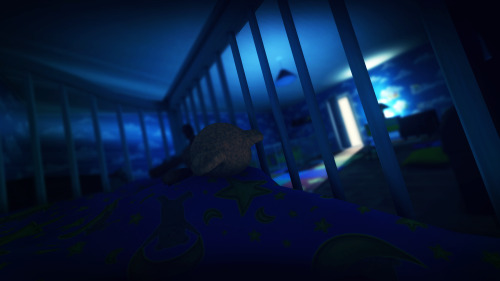
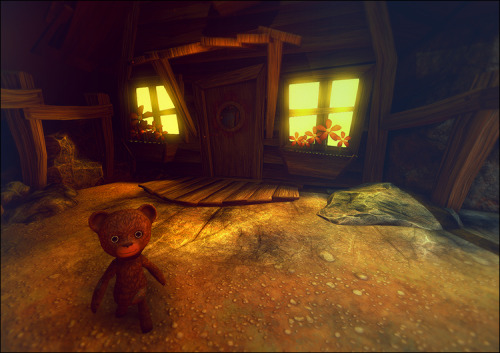
In “Among the Sleep”, you are a two years old, and it is your birthday. Following a rather glum birthday party attended only by your mother, who is interrupted by an angry knock at the door and comes back without explanation, she sets you to bed early and you wake up in the middle of the night to find your Teddy Bear dragged into the dark and the house transforming around you into the place of your nightmares. When you free Teddy from almost-drowning in the washing machine, he tells you what you already know: you need to find your mother. The rest of your journey is spent exploring the house and the strange landscape of horrors that await you in your dreams.

Being a first-person game, you spend the entire experience from the viewpoint of your character, exploring a 3-dimensional space by looking around and moving. For a new gamer, getting used to this system can be disorienting, nauseating, and frustrating, but unless you're my dad, you'll get the hang of it. First-person exploration allows for a beautiful type of storytelling that only video games achieve: you, as the player, are able to observe and come to conclusions based on what you see. The cameraman doesn't have to frame it a certain way for you (though the experience is much like heightened cinematography) and there can be secrets and insights all around. A child's drawing on the floor can be walked over or you can take a moment and learn something about your character. “Among the Sleep” has some beautiful moments of ambient storytelling, and in this way can serve as a wonderful introduction to the great first-person games, games like Half-Life 2, the Bioshock series, and Dishonored.

The game takes advantage of your position in the world to great effect, and was one of the game's great successes for me. As a toddler, walking upright is slower and more clumsy than crawling, but it's only when standing that you can hold your Teddy Bear, comforting you and creating a little golden light in the sometimes-pitch-black darkness. The limits set for you create an amazing sense of smallness: doors and drawers can be very finicky to open, climbing onto surfaces is clumsy and accompanied with frustrated baby noises, and interacting with objects changes in difficulty depending on their size. Basketballs seem like immovable boulders, hanging dresses seem like silent specters, and hallways seem endless. I found myself so drawn in to the role of a child that I felt unable to speak aloud—something I occasionally do in frightening games—and felt powerless in the face of the terrors before me.


If you're like me, you may want to know how frightening “Among the Sleep” is before you consider getting it. It's honestly not that bad. There are no bodies, no bloody scrawls on the wall, no psychologically disturbing images. The game relies on suspense and your feeling of helplessness to create its experience. The sound design is full of strange noises and creaks that will make you swear under your breath when you open a squeaky door or break a bottle. The level design is somber, dark, and creepy, and there are a number of moments to make you jump out of your seat. There are monsters that had me breathing heavily and crawling like a jitterbug for my baby life, and the sequences of being pursued are heart-pounding, but the game will not give you nightmares.

It is, in itself, a nightmare, a beautiful artistic depiction of what makes children afraid. Rooms that seemed familiar to you are transformed, a playground filled with somber-faced owl statues becomes a creaking, foggy marsh, and indistinguishable arguing adult voices float in the background, hinting at the real-life dramas that might influence this child's fears. The result is an experience that is chillingly nostalgic, recalling primal moments of childhood when the words “No, honey, not now” were the equivalent of a death knell and when the darkness seemed ready to swallow you up.


(I'm amused as I write this at how similar it is in theme to Child of Light. Why games about childhood? Partially, I suppose, to refute the idea that all games are about killing people, and even the ones which portray it are often about more than that. Partially because art about children affects me a lot.)

Why do I think you will enjoy this one? I enjoyed it because frightening first-person games are much more fun than horror movies. I can't stand horror movies, but in a game like this you have to choose to go into the dark room. No camera angle is forcing you to see the scary thing (I spent probably more than a minute and a half hiding behind a refrigerator door because something was moving on the other side aaaaagh). If you want to follow Teddy's advice and find your mother, you've gotta move your chubbiness into the dark and see what's waiting there. It's an exhilarating, chilling way of experiencing a story. The puzzles are interesting without trying to stump you, and the pace and length is very good for an introduction to the genre—about 3 and a half hours, depending.

It has a few weaknesses. Its voice acting, besides a few really shining moments, comes across as clunky and passionless. Though the sound design is fabulous, the music doesn't really shine very much and has very few memorable moments. This may be intentional to imitate a child's understanding of music, but I would have liked to have something to hold on to when I got to the end. And this third is a strange weakness, but a small prologue that was developed later (now included in the game when purchased) has been added on, and it showcases a slightly-better-designed experience that shows how the game could have been better with more time in development. But both are still the same world experience and quite enjoyable.


So give it a go. Find someone who you won't be embarrassed to get scared sitting next to, cuddle up one late evening, and walk into a nightmare together. “Among the Sleep” speaks a language that children understand—a language of toys and memories, of moments with Mom and of childhood fears, and the result is so clearly-communicated that I recommend it wholeheartedly, The story, seen through a child's eyes, is surprisingly moving for a game about finding your way through a scary dream. I want to talk to you about it when you finish.


“Among the Sleep” is available for $19.99 through a legal and safe internet client called Steam. If you're lucky, you'll find it on sale, as I think the game would be better priced at around $12.00.  

Friday, December 19, 2014

Mormon, Breaking Bad, and the Morality of Art

The penultimate author of the record known as The Book of Mormon, an almost-thousand-year history of a doomed people, describes its waning days vividly and horrifically. The spent general, whose name now adorns the book since he compiled it, lived his final years leading doomed armies, while attempting to finish a history that had almost no chance of surviving, hoping that one day his genocidal foes would find it and their descendants would regret the bloodshed they had caused.
“It is impossible,” he writes, “for the tongue to describe, or for man to write a perfect description of the horrible scene of the blood and carnage which was among the people...and every heart was hardened, so that they delighted in the shedding of blood continually.”

But in the chapters that follow and some preceding, Mormon continues to give us glimpses of the horrors. Rape and cannibalism and human sacrifice rank high among these crimes, but for the soon-to-die prophet/historian, nothing seems to cause him more misery than the body count. As a general, he knew what numbers signified, and the absurd numbers that mount into hundreds of thousands.
“O ye fair ones!” he laments, words one can imagine him shouting at the piles of bodies mounting across the fields, “Behold, ye are gone, and my sorrows cannot bring your return.” The despair, cynicism, and sorrow written across the final chapters of the Book of Mormon strike a sharp contrast to the clinical historicism of the Old Testament and the mix of stories, doctrine, and discourse in the the disconnected New Testament.


Mormon makes a caveat for his readers. He is very sensible of those who might one day read this, and is careful about their feelings:

“I, Mormon, do not desire to harrow up the souls of men in casting before them such an awful scene of blood and carnage as was laid before mine eyes.”

He is concerned about upsetting his audience. Having seen the horrors of war and wickedness, he doesn't like the sight of them and isn't trying to shove them in people's faces. He continues:

“but I, knowing that these things must surely be made known, and that all things which are hid must be revealed upon the house-tops...therefore I write a small abridgment, daring not to give a full account of what I have seen, because of the commandment which I have received, and also that ye might not have too great sorrow because of the wickedness of this people.”

The doctrinal point Moroni brings up is that in the final judgment, all wickedness shall be made known. There will be no secrets, no things hidden, nothing brushed under the carpet. He explains that he is partially using the record of these horrors to teach something. He isn't trying to scare us or make us feel sad about evil, in fact, he says it twice. He is careful to be brief about it, and to leave out the gruesome details, but the story he tells is not whitewashed, changed, or defended. He wants the people who read his book to be changed. He wants them to know what evil is, how it is born, and how it ends—horrifically.


I have recently been watching “Breaking Bad”, created by Vince Gilligan. I am partway through season 2, and if you're watching the show I'll be talking about details of the show up until my current place, trying to avoid major spoilers. Honestly, I don't think you should worry about it. The show moves so fast that spoilers are coming every episode. I'm sure I'm on the edge of some new insanity. I want to write about a million posts about this show (its kinship with Shakespearean tragedy, its structure, its acting, its character-development) but today I'll just do a bit of an overview and talk about morality.

breaking bad Schlimmer gehts immer: Warum Breaking Bad auch in der fünften Staffel einzigartig ist

Vince Gilligan's massive yarn centers around a single man, Walter White. Walter is a chemist, a high school teacher in his middle age who is powerfully overqualified, having once contributed with his work to a Nobel-prize winning project. He is married to the lovely and uptight Skyler and has a high-school age son with cerebral palsy. To make extra money, he works at a car wash. Walt collapses one day at work and learns that he has terminal lung cancer, and has less than two years to live.

By a strange series of events involving his brother-in-law, the bawdy, chubby DEA agent who brings Walt on a drug bust for crystal meth, and a former student Jessie Pinkman who is the dealer of said crystal meth, Walt, an extremely clever man, makes the strangest possible play for his family's benefit and his possible recovery: he decides to use his chemistry skills to make and sell crystal meth.
Its setting is so normal as to happen in our backyards. The Arizona mountains and suburban houses and issues are as everyday as “what's for breakfast?”. In a milieu of TV shows set in CIA offices, invented lands, and far-off planets, Breaking Bad is chillingly now & here. There is very little room for distance when family discussions and dramas come so blindingly close to our own. Though Walt's secret is at times much greater than most people could possibly claim, the challenges are the same. Walt is a man who desperately wants his family to be happy and safe. Its very simplicity and familiarity make the violence and conflicts deeply disturbing.


 Breaking Bad Family Schlimmer gehts immer: Warum Breaking Bad auch in der fünften Staffel einzigartig ist

The show leaves no stone unturned and no dark corner unexplored when it comes to normal people descending into the world of organized crime, drug abuse, and eventual murder. Episodes can hinge on police raids that end in exploding land mines just as much as they hinge on tearful conversations between family members who are coming to distrust each other.

At its core, the show is about evil. The title Breaking Bad contains several meanings (chemistry involved) but one of its most fundamental is that the center of the show is a tight handful of questions: What does it mean to be bad? Who is bad? How does one become bad and at what point do good intentions become bad? What does the good/evil composition when it comes to human nature? How does it work?

To answer this question it displays an array of human sins and human goodness. Skyler's sister chooses to shoplift, and makes a habit of it. Her husband is an ignorant racist, pushing down Latinos and refusing to learn Spanish in favor of his stereotypes. Skyler, under extreme stress, smokes three cigarettes while pregnant. A drug lord named Tuco bashes in the ribs and heads of his disobedient minions. A pair of meth heads have had a child who they ignore completely, who in his squallor watches informercials and says only “I'm hungry”. Walter chokes a man to death with a bicycle lock.
But on the other hand, these people act in courage and goodness. Skyler's sister is a faithful friend and gives many of her stolen items as gifts. Her husband saves Walt's life in a daring gunfight where he displays such heroism as to seemingly erase his ignorance, stupidity, and lewdness. Despite her fear at Walter's strange behaviors, Skyler is incredibly faithful to helping her husband, devoting all of her energies to his survival in the face of cancer. Even Tuco, the murderous drug lord, owns a small piece of property where his aged, ailing grandfather lives, who he takes care of in his old age with a strange maternal sensibility.

Walter's journey takes him deep into the world of crime and into his own morality. A sort of atheist, he still writes on a pro's-con's list of the decision of whether to commit murder: “Judeo-Christian Values”. He shudders before his own decisions when he must contemplate them, but then acts boldly in pursuit of his goals. The name he takes upon himself, “Heisenberg”, after the Uncertainty Principle becomes the way the audience sees him—an unguessable mystery, making breakfast for his family in the morning and starting large scale drug warfare in the evening.


It's hard to tell if “Breaking Bad” delights in bloodshed, which Mormon clearly opposes, or if it is an indictment against it. Personally, I think that there are obvious moments where the filmmakers are excited about what they are showing. They know the moment is shocking or frightening or fascinating, even if it is violent. But I don't think the writers for a single moment (at least so far) delight in it. The show spends time and time again slogging through the trough of justification, watching characters we believe in decide to do horrible things despite our knowing they shouldn't. The promotional materials make these characters seem like action heroes, but the writing makes them human beings.


Many people say of this story that it justifies Walter, that one comes to love him and root for him despite his evils. And of course, in a sense, it does. We watch things fall apart and think “no, no, no, don't let everyone find out what you're doing”. As with ourselves, we want Walt to find an escape, to be safe doing what he wants to do without consequences.

But his sin is clear. Walt is the personification of pride. Spurned by the universe in the form of his wildly-successful former colleagues Elliott and Gretchen, he feels that his middle-class, cancer-ridden, unfortunate existence is the result of some great plot against him by the universe and so he decides to reverse, gauging himself as smarter than chance. When things turn against him in his everyday life, he can use his power in his second life and prove that he is better.

Who of us does not feel like Walt, or his brother-in-law, or his wife? Who does not feel that our worth hasn't been amply reflected in the rewards we've received? Who doesn't feel that our status in whatever sense doesn't excuse some bigotry, some lustfulness, some unkindness? Who doesn't feel that our love of others excuses our sometimes-insane attempts to make them do what we want, or act in a way that accords with our hopes?

Breaking Bad, unlike any piece of moral theater I have ever witnessed, weighs all acts as the same. Like the record of Mormon, it knows that all sins will be shouted from the housetops, and it gives every sin its time. The message that rings out to me is desperately clear, which is: evil is evil. Justification is the same for everyone, and some things require more of it, but it is all meaningless. Does it matter to be the greedy meth-head calling his girlfriend a skank at every opportunity, or the girlfriend who, in a drug haze and at the end of her wits with his cruelty, crushes him bodily with an ATM machine? In their filthy house where a child sits abandoned and ignored, the question of blame is beyond us.

The vision of Breaking Bad shows our world, so crippled by sin that we want to look away, to pretend it doesn't exist, to hide it under the rug. But every characterization is careful. Every stereotype is thrown aside. Nowhere are such morally real characters represented than in this show, and as I watch the train wreck that I am sure will some day soon fall upon Walter and Jessie, I think of Mormon. The people he mourned for were dead and gone, but today we are not yet dead. There is time to repent. There is time to pull away. Though I rarely feel like rejoicing after an episode, I feel like remembering. I feel like understanding, I feel like considering.


Vince Gilligan's sprawling parable of pride and choices reminds me of the great teller of parables. Christ told of robbers who left a man naked and left for dead on a highway. He spoke of a man trapped in hell, wishing for just a drop of water to place on his tongue. He spoke of vengeful servants who killed the landowner's son to steal his inheritance. He wanted to teach us. He wanted us to pay attention. He wanted us to learn something.

Watching exploitative or pornographic television shows for enjoyment has many harms, can disconnect people from reality, and encourages our imaginations to allow new and sometimes awful possibilities. Watching morally responsible works of art can frighten us, harrow us, and teach us anew the difference between good and bad. Only we can be responsible for why we do what we do, and how it affects us. I firmly believe that a rating is not the difference, but our own intention and preparation can make the difference. I don't recommend that everyone watch Breaking Bad, I'm recommending that we learn from the stories that we take in.

Do we need more sacred, uplifting art? Yes. Do we need to reject the difficult art? Not always.

It does not matter if you are a stressed-out mother or a maternally-minded drug lord with a horrible temper problem. It does not matter if you are an addict, a high-schooler, a brilliant chemist, a DEA agent, the man who won the perfect girl or the man who felt like he always settled, you have a soul. You have a life of which you can choose to make good or ill. You can choose in the name of whatever petty outcome you hope for, but in the end there is almost nothing more precious than goodness: true selflessness, true honesty, true humility.


I learned that from Walter White and the prophet Mormon.

Saturday, September 20, 2014

The Question You've All Been Asking Me (A Review)

My friends, you often approach me with a question.

"Ted," you ask, adjusting your hip glasses, or putting a thoughtful hand to a thoughtful chin, "I'm open-minded and fascinated by the arts and what they can accomplish.  You are a storyteller by trade, and we have spoken of these things because we are friends.  You seem to enjoy video games and the stories in them.  If I was to play a video game, what would you recommend?"

My friends, you have asked me oft, and I have become ponderous.  At the masked balls where we have spoken, or under the vaulted ceilings of museums or cathedrals where we have met by chance, I have not been able to find a response.

I think I finally have found the game, or one of them.  Each of you have your own likes--some in the flying of spaceships, some in the wielding of swords, some in the touching stories of well-written characters, and so on--so I may have to write several such articles.  But here is the first: it is called Child of Light.

Image result for child of light

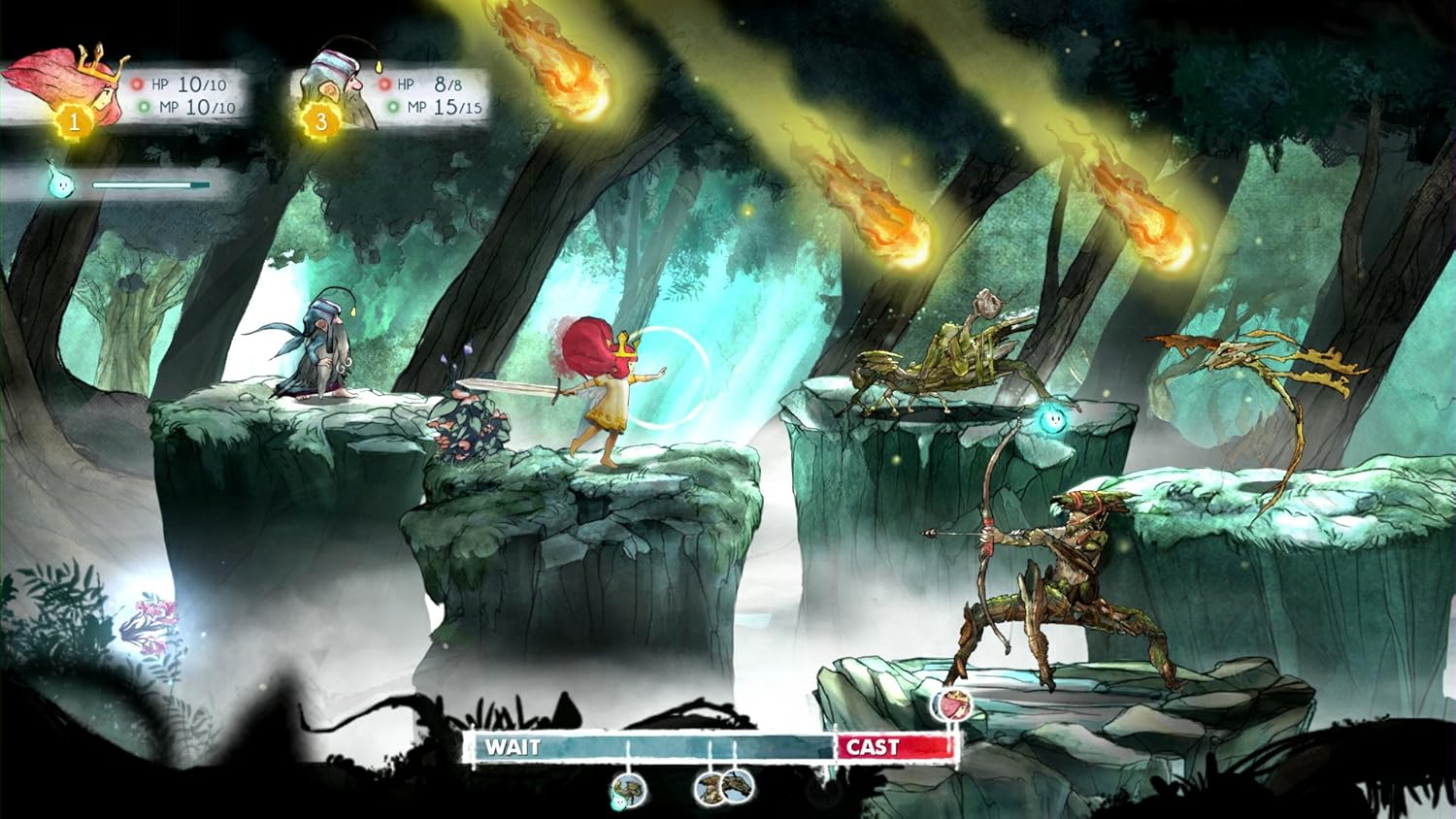
Child of Light is a sidescrolling RPG developed by Ubisoft Montreal, drawing on Active Time turn-based JRPG elements.  I see you're lost already, but don't be afraid.  I have made some of the words blue so that they lead to further knowledge.  The others I will explain myself.

The game is about a young girl named Aurora, the daughter of a duke, who dies in her sleep.  She wakes up in a dark, moody land full of strange creatures, where she makes friends with a firefly that might be able to lead her to find her father, and a way out of this dark place.

Child of Light might work as your first game because it is a simple, traditional game, and one of the most moving experiences I have had recently in which the mechanics of a game have allowed me to better understand my life.  Aurora's journey through a difficult land shows the melancholy journey of a child learning about sadness, and the power of friends.

A BIT OF EDUCATION: Role-playing games like Child of Light generally have three parts or activites: first, the visiting of towns or cities, which consist of talking with people and obtaining quests (because, in RPGS, you are the only person capable of helping anyone else out, which can become rather fatiguing), second, exploring dungeons, caves, and fortresses and defeating evil things, and third, completing quests.  Quests can be completed in many ways, for example by clearing the old woman's basement of crabs, rats, or giant ants, by convincing the Czerka Corporation that their exploitative terraforming measures are going to destroy life on Telos IV, or by vanquishing the dragon/demon/Sauron/Ganon and lifting the veil of darkness over the world.

Image result for child of light


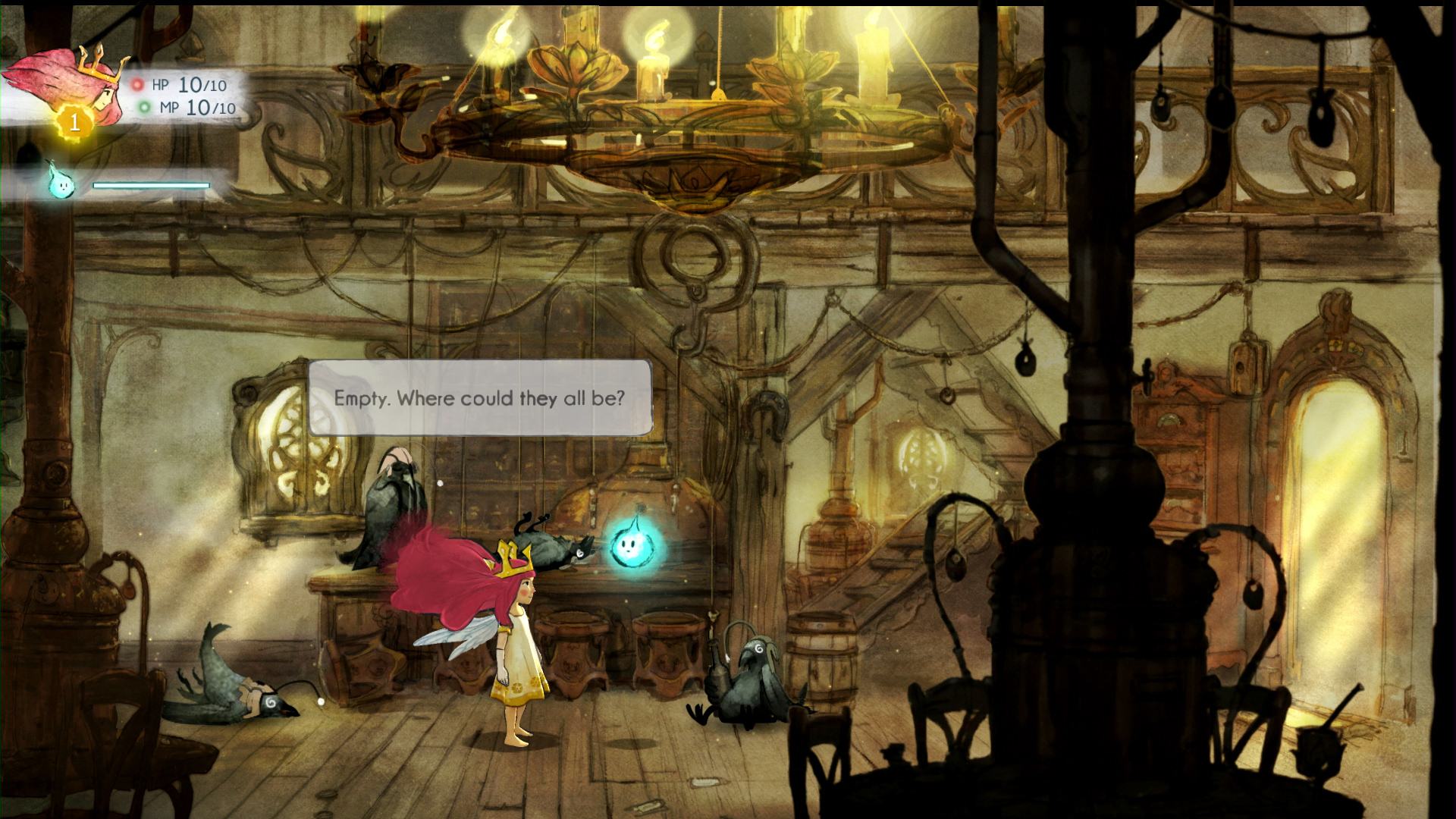
I recommend Child of Light partially because of its art.  Completely composed of hand-drawn illustrations, the world Aurora explores is at once inspiring and unsettling.  The deftly-animated protagonist floats from dark twisted woods to ruined castles.  She finds a city filled with mice that talk about the stockmarket, a village filled with Scottish dwarves who have accidentally been transformed into ravens, and she dives into the lava-filled innards of a mountain giant woman.  The music that accompanies it is often sad, yearning, and filled with a sense of searching.  In sequences of exploration, I felt connected to Aurora's search for her father, because in this world everyone is looking for something, and here it is easy to become lost in frightening places.

I won't ruin the story, but there is a lot to it.  It has some weaknesses--the whole thing is written in one of the worst rhyme schemes I have ever read, but I got used to it.  And in light of its dark subject matter its comedy can come across as less intelligent than its design.  But these are all forgivable in light of its strengths.


Another important aspect of RPGs I think you will like is your party.  Like the Fellowship that goes from Rivendell to Mordor to destroy the ring, a party in an RPG is a group of people united by a cause, each with their own strengths and weaknesses and their own story.

Child of Light's cast of characters, like Aurora, recall the serious psychology of children and the deep sadness of life.  A circus artist's air balloon took a wrong wind and she has been separated from her brother.  A dwarf wizard is afraid of spiders, but needs to face a cave full of them to save his tribe.  A non-party character, the giant Magna, is old and tired because her heart has been taken over by evil creatures, and a long quest must be taken to remove them and heal her heart.

Their characters come even more to life in combat.  When you fight foes in Child of Light, you enter an intricate turn-based system that will take some getting used to, but which is very rewarding and enjoyable once you've acquired the knack.  In order to defeat your enemies, Aurora and the party must work together in strategic, well-timed tandem, and their abilities reflect their relationship with Aurora: her sister Norah in particular has no attack abilities of her own, but can speed up Aurora or slow down her enemies.  What a beautiful game-based metaphor for the influence of a sibling's love. 

It made me wonder what my role would be in such a party.  Would I be a healer, capable of bringing my friends back when they're down?  Or would I be a wizard, with the power to vanquish fears and enemies with powerful spells?  Would I be an archer, capable of holding back many oncoming stresses, and preventing danger to my friends in advance?  And I wondered, in turn, about you, my close friends.


Image result for child of light

It was hard being a kid.  The world was and is full of scary things, and children, having never faced them before, can fear them more.  You remember when you broke a dish and thought your parents were going to follow through on that facetious promise of eating you alive?  Or when a playdate with someone who you were scared of turned into a nightmare that might have no end?  People tell me they wish they were kids again because life was so carefree, but I look back and remember being the thoughtful child who worried a lot, afraid I didn't have any friends and never would, or worried that I had ruined everything with my latest blunder.  In the end, what changed that for me was making friends.

In this fairy tale and in your own life, the protagonist wakes up in a land that is unfamiliar and difficult.  As it always is in these stories, something is wrong with the world--a dark queen of night rules the land, and the young mostly-helpless child must save it, with a little help from her friends.  Child of Light reminds me how you, my friend, can help me fight darkness, and that we can be characters in someone else's party, used in a battle against a boss at the moment when we are needed.

Child of Light is available for $15, downloadable through a completely legal and safe internet client called Steam.

Thursday, August 7, 2014

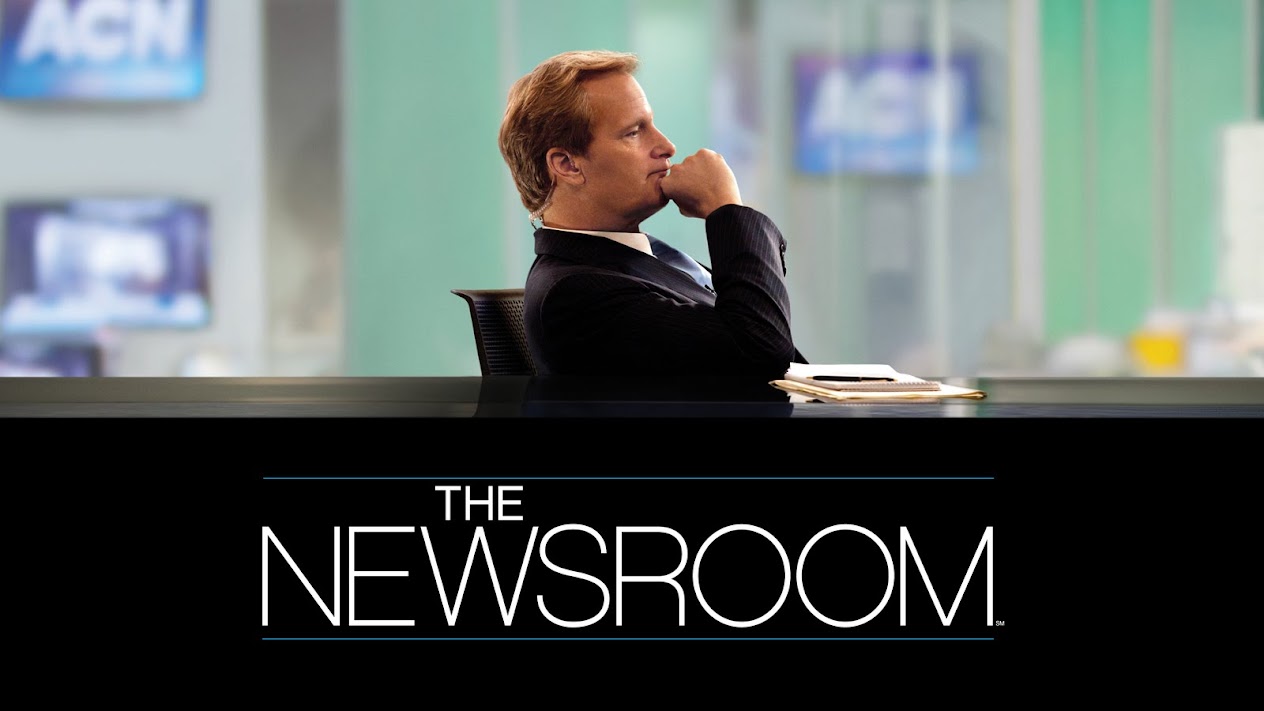
"The Newsroom" Pitches An Inspiring Angle


I don't watch the news, and I'm not sure Aaron Sorkin does either, but I like what he's been reporting on HBO these days.  His offering, an hour-length TV drama, follows the journey of Will McAvoy (Jeff Daniels) and Mackenzie McHale (Emily Mortimer) as they attempt to make personal and journalistic integrity the center of their nightly news show.  With a characteristic cast of choleric, charasmatic newscasters, Sorkin tells an idealistic story that, in the end, is less about the news and more about modern-day challenges of integrity.  While its politics vacillate between delightful incisiveness and patchy melodrama, its real heart is in its well-portrayed core cast and the optimistic perspectives of its author.


Aaron Sorkin is a TV-writing legend, mostly because of The West Wing, which he wrote for four seasons before it was passed on.   He also wrote "The Social Network", a film about Mark Zuckerberg and the creation of facebook.  His writing is characterized as fast-paced, wordy, and intelligent, and he is so popular among theater and film practitioners that words like "Sorkinesque" exist and are used with frequency.  I knew what they meant before I had seen anything the man had written.  So that's cool, and of course begs the question of The Newsroom's place in his oeuvre and in the newly-exploding television medium.  Is this the peaking triumph of his career?  Is it a sold-out side dish to his better stuff?  Sadly as I have not watched The West Wing (I've gotta finish Galactica, which I have been working on for two years) I'll have to tell you some of that later.

The show is really quite fun to watch.  Shot in the hustle-and-bustle of a spic-and-span newsroom, the show focuses on the enjoyment of watching people do what they're good at.  Jeff Daniels as McAvoy is a bitter hero, an anchor who has suffered for his honesty and for his temper, and who now begins a "mission to civilize" at the behest of his ex-girlfriend, who now is also his executive producer, a clumsy and emotional idealist played by Emily Mortimer.  She's a fantastic actress, and though she's a little underwritten, her relationship with Will is believable and a great through-line for the series.


The greatest strength of the Newsroom's cast, however, is its young people.  Jim Harper is the new kid on the block but takes charge immediately, and John Gallagher, Jr. is the kind of guy you want to trust as your peer and your boss, devoid of ambition but full of passion.  He develops feelings for Maggie, a frenetic, hilarious associate producer played by Alison Pill with exactly the right balance of timidity and courage.  Their furtive-glances-but-she's-got-a-boyfriend relationship is what TV is made for, allowing the audience to groan over how good they are for each other and how much tension is building up.

The other characters create a dynamic team: Maggie's temperamental boyfriend Don (Thomas Sadoski) provides inner conflict and impatience, while Neelamani Sampat (Dev Patel) is stereotypically tech-savvy and nerdy but as a fully-fledged human being, emotionally clear-thinking and a faithful friend.  Olivia Munn's economics expert Sloan Sabbath provides humor as a total bombshell who thinks more about the debt ceiling than about human feelings.  The other supporting characters, while well-written and performed, pale by comparison with the young people, whose aspirations drive the whole show.


The story is patchy, sadly.  Most episodes attempt to pair personal ethical problems with news stories, for example an episode about the Tea Party and lying on television mirrors the news story with questions about personal honesty.  At best, these episodes can be smoothly built, aerodynamic, and a rush to watch.  At worst, they seem heavy-handed and one-sided.  (Sorkin's McAvoy is apparently a card-carrying Republican but spends most of the show throwing stones at his brethren, and it gets a little old even to this moderately-minded observer) Still, with the snippy dialogue and strong throughline stories, the show's flaws come across as forgivable.

We live in an era of anti-heroes, and The Newsroom can look silly in that light.  Maggie and Jim wouldn't last ten minutes in Westeros, and Walter White wouldn't give them a second look.  There are no hidden dead bodies, no decapitations, and I was shocked to have finished half the season of this HBO series without any exploitative sexuality and barely any innuendo.  Sure, there are F-words aplenty, but they are for emphasis, not cruelty.  In terms of content, the existence and relative success of The Newsroom is a marvel.


My conclusions about The Newsroom are not about politics; they are about people.  Sorkin presents and believes in a good world full of good people trying to do their best.  Each of the individuals he presents deserve to be loved by people who understand them.  They make mistakes that are less related to crime and more to emotional oversight or unkindness.  This is a light that I am happy to see myself in.

In my review of Star Trek: Into Darkness I praised the idea of having a crew, how if we want to change the world, we must work alongside our friends.  Sorkin, I think, realizes how much television and stories in general are life-fuel for people, and that messages like this can inspire us.  He knows that somewhere watching, there is a young woman who might eventually be president, a young man who might eventually be a news anchor, and a multitude of people who already live in a world where moral decisions are made and moral consequences exist.  The Newsroom reminds us that integrity is a fight worth fighting.

The fact that cynical critics pan outright optimism does not kill its benefits.  It's A Wonderful Life was called "Capra-corn" and my father hates it, but it still inspires me to serve other people and live a selfless life when me and my mom watch it on Christmas eve at 1 a.m.  I believe that life is a fight worth fighting, and I appreciate art that reminds us of our moral agency in it.  And as a character on the show states, if that term is too vague for you, look it up.  Then watch The Newsroom, then go be a good influence in the world.

Not necessarily in that order.


Friday, May 30, 2014

Godzilla, Science Fiction, and Polymaths


I saw "Godzilla" on Memorial Day.


It was pretty cool, I suppose.  Lemme give you the rundown.

Scientist Bryan Cranston and stuff-nasal-voiced hunk Aaron Taylor-Johnson are sad because BC's wife died in a suspicious prologue.  They have to overcome their father-son issues, I think, which involve dad being the kind of scientist who (loud sigh) posts newspaper articles on the wall.  "I know, it's the worst idiosyncrasy, but the only way to respect your mother's memory is by becoming a conspiracy theorist."

Then for plot reasons, there are huge.  huge.  monsters.  Partially I don't like them because none of them are MothraGhidorah, or Gigan.  Then Godzilla shows up, more like an afterthought than a built-up, meaningful Second Coming, and fights them.  And then there is destruction and smoke and fog and a lot of staring at intense stuff, and then the monsters are gone and the movie's over.  Seriously, done deal.

I loved these films as a child largely because of the monsters and largely because I was a child.  I know that I am using a much less appeasable instrument (adult brain) and comparing it to distractable ten year old brain, but I watched half an hour of "Ghidorah: The Three-Headed Monster" on Netflix and enjoyed that much of it Way more than this new, apparently good reboot.


The new reboot is not good.  Trying to find the flaws in Godzilla is not hard.  The problem, in fact, is listing them.  The film is more about being a reboot than anything related to monsters or Japan or even Bryan Cranston.  It relishes in greyscale.  It refutes campiness by resorting to a tone of unending dreariness, so much so that Ken Wanatabe was payed (hopefully) a million or so to STAND LOOKING OUT AT THE WATER WITH WORLD-WEARY WORRY.  He probably has six lines, one of which is the obligatory (never happy) only sighting of the world "Godzilla".  The monsters fights are mostly skipped over, as if saving us from the experience we paid money to see.  Pacific Rim was thirty times more fun and even if the writing was campier I actually enjoyed the freakin movie.

I'm just gonna stop reviewing the movie right now and tell you what's up, and this is actually what this post is going to be about: Movies are doing fantasy and science fiction wrong.

I repeat: They're doing science fiction and fantasy the wrong way.  "Why do you say that?" you ask, adorably naive reader, "There are sf & f movies all over the place?  All these comic book movies, not to mention all of the adaptations of children's lit like Hunger Games and Divergent, plus The Lord of the Rings and The Hobbit and everything else that's been engendered by it!" You're right, they exist, and some have been nice, but most aren't right.

Science fiction is a place to explore new ideas.  You would be shocked to know how many incredible inventions and ideas of today can be traced back to a few writers.  William Gibson's "Neuromancer" is theorized to have played a key role in the invention and development of the internet.  Neal Stephenson's novels have never been smarter or cleverer commentary on culture and technology.  And fantasy is no exception.  Where science fiction makes science into magic, fantasy makes magic into emotional reality.  Great fantasy writers like China Mieville, Neil Gaiman, and others allow us to see the world in splending, colorful new ways.

The entertainment machine, the hydra with such recognizable heads as Disney, Legendary Pictures, and HBO, has seen half of this world--they have seen the money.  They've seen nerdy boys apprenticed by their fathers in the way of science fiction, given books that change them.  They've seen how these nerdy boys spend money--lots of money--buying more books, or games, or comics, or whatever.  It inspires something in them, and inspiration, as we all know, means box office sales!

But it also means reduction, which is our first (1st) problem.  "Yes, we can make movies with spaceships and dragons and robots and all the things you want, but they're going to be movies.  Action movies, with lots of explosions and enough drums and percussion so no one gets bored or has to think too much.  Delving with issues or figuring out themes that matter is for dramas.  Except those will probably just be more about sex or murder."

So that's obvious.  I'm not saying anything new, just complaining about the commercialism of film.  Obviously they are trying to entertain.  Or I should say "we", as I am also a professional in this business at least to a degree.  Entertainment is important, and selling tickets is important, and though people are not as foolish as to simply want explosions and violence, they also aren't looking to read some new philosophical manifesto every time they walk into a theater.

So our second (2nd) problem isn't related to money.  It's related to the entertainment industry and specialization.

Specialization is an old time-honored thing.  You want to do something, like be a film director.  You get training, whether it be from Obi-Wan Kenobi or from a university or both.  Then you are qualified to a degree and join the ranks of people who have specialized.  Other people, who have not had the training and are thus not a part of the community, simply are not a part of it because they don't have the specialized skills.  They're not "special" in the right ways.

This system has worked for a long time, and is failing us now.  Why?  There are lots of people who want to do entertainment.  Lots of people want to be film directors and writers and actors, and so it's hard to know who to trust.  Walk down the street in NY and ask for a raise of hands "Who's an actor?" You'll get a lot.  Even though you're weird for asking for a raise of hands in public.

So now, instead of just specializing, we network.  Afraid of unknown quantities, communities of artists become centralized, trusting certain people and working with them.  This works great for many individuals and many communities--people get to work with people they like again and again, and they can feel comfortable and safe in their careers.  Entertainment can be especially scary, so it feels very safe to have a group of friends who are also co-workers in a sense.

But This.  Hurts.  Art.  There are diverse individuals in different communities who could work well with each other.  It's amazing to me that a mind like Neil Gaiman's and a mind like Christopher Nolan's have never met up and done a project.  It's far more likely that director Guillermo del Toro will turn to some friend from college to co-write his screenplay than to call up China Mieville, who would be an incredible match.  There are science fiction and fantasy authors out there capable of writing incredible films.  It's not like there are no good writers and we Have to turn to some doofus to write the screenplay for Godzilla.  Get a real writer to do the science fiction, and Max can put it in screenplay format.  I mean, the science used in Godzilla is at about the seventh-grade level.  The big reveal of the movie revolves around the idea of ECHOLOCATION.  I knew what that word meant in second grade, and I knew it related to bats and communication.  Who pooped out this screenplay?  Yeah, the formatter doofus.

The world values polymaths (Renaissance Men, people who are experts at many things), and so we all want to be them.  Joss Whedon is an inspiration to lots of people because he has roots in SF & F but makes great movies and writes great dialogue and also writes music, why not.  And so everyone wants to be him.  Every young director wants to write and direct, and hopefully star in his movies.  But being a polymath is not a matter of ego.  When it is, you often make crappy movies.

Being a polymath is a matter of being abso-freakin-lutely insane.  Polymaths are obsessive.  They are nerdy and often socially difficult.  They work their butts off day and night to keep up with the things they are good at.  Sometimes they might pick up new skills, but it's never without effort or work.  It's because they are willing to put in the time an really do it right.  There are incredible people, but "just being you" doesn't qualify you.  Even if you are hardworking or talented, it doesn't qualify you.

But heck, don't worry about that.  Polymaths are not the solution to bad movies, or bad science fiction and fantasy.  The solution is people doing what they're good at.  It's really seeking to make good art, even when we have to put aside working with our friends or the people we like, or getting the most money for it.  I think that really, really matters.  And even if he can't always tell the difference, I think ten-year-old Ted does too.


Monday, April 21, 2014

Surviving and Not Much Else In '12 Years A Slave'

In her review of '12 Years A Slave', Roxane Gay said: "I am worn out by slavery and struggle narratives.  I am worn out by broken black bodies and the broken black spirit somehow persevering in the face of overwhelming and impossible circumstance." Despite the incredible praise that has been lavished on "12 Years a Slave", Gay and other reviewers bemoaned that the film is rehashing another version of the same tale, packaged for Hollywood audiences in yet another way.  I have sometimes felt the same things about "historical suffering" pieces.

So I came into '12 Years a Slave' looking for something other than guilt and sadness.  I came looking, perhaps selfishly, for strong performances by actors, and for elegant writing.  I found both.  Chiwetel Ejiofor plays Solomon Northup, a free black man from the North who falls in among the untrustworthy, finds himself abducted and sold, and spends (obviously) a dozen years as the property of a lineup of southern white men.  In his performance and in the screenplay, I found not just what I was looking for, but also some questions about human beings that I think elevate the film above melodrama and into the realm of art.


Human beings are all anyone encounters in John Ridley's screenplay, and they come in many shapes.  Solomon's first hawker, a well-dress Paul Giamatti, tells his customer (Solomon's future owner Ford, played by Benedict Cumberbatch) "my sentimentality extends the length of a coin." Overseer Tibeats, played by Paul Dano, commands a new batch of slaves to clap for him on their first day as he sings a demeaning song about runaway slaves.  In a chilling scene, a black woman who has gained a life of relative ease by marrying the white plantation owner who loved her invites Solomon to sit for tea and reflects eloquently on the world she lives in: "If [enduring Master Shaw's pantomime of fidelity is] what keep me from the cotton pickin' niggers, that's what it is to be.  A small and reasonable price to be paid for sure."

Like almost everyone in the film, these characters are survivors.  Slaves "say and do as little as possible" to avoid the whip or the noose, guilty slave owners must pay their debts, and the others scrape out their living where they can in the established system.  Only Solomon seems to dream of something else, proclaiming: "I don't want to survive.  I want to live."


But as the film shows us, living is barely an option.  I rejoiced vocally when Solomon stole the whip from Tibeats and made him scream with whipping, and even breathed a sigh of relief when another overseer told Solomon that he would protect him, but the subsequent moments left Solomon hanging by his neck from a branch, his feet barely touching the ground and keeping him from death.  In an agonizing long shot slaves and slave owners alike ignored the hanging man, save one girl who brought him a sip of water and hurried away.

It is in this and other scenes like this that slavery can be understood as it truly was--a monster of civilization, nearly indestructible and impossible to fight.


Praise is deserved for the many actors who contribute to this.  Cumberbatch's Master Ford barely has four scenes, but his rich voice and manner embody the period and the kind of goodness that men like Ford offered--scripture, attempts at justice, protection, but in the end not much else.  Dano's Tibeats is despicable, sniveling, and hateable.  What a sad career that guy is having.  And it's impossible to forget Michael Fassbender's wild, egomaniacal Epps, a lusty, boozing farmer.  Fassbender plays him as part Nazi, part Shakespeare villain, reduced to nothing but desperate selfishness.

Solomon is a treat to watch.  Ridley's text is heightened like Arthur Miller's Crucible, and no one gets it right quite like Mr. Ejiofor.  His performance is at times so subtle as to almost disappear, but when the fire burns, it burns, and it's hard to take one's eyes off him.  Lupita Nyong'o plays Patsey, Epps' concubine and the best cotton-picker on his plantation.  Ebony-skinned, with wide eyes that rarely look at anyone, Patsey is a pathetic symbol of the race--hopeless, meaningless, making dolls out of grass and fighting the most desperately when it comes down to a bar of soap, as she screams at Epps: "I stink so bad I make myself gag!"


For those who saw the trailer and Solomon's vigorous declaration: "I will not fall into despair!" This statement is tragic.  Despair is much of the film's purpose, and by the end the words echoing in my ears were not Solomon's wife's final comfort but instead Epps' wrathful cry in Northup's ear: "I own you!  I own you!" In the end, Solomon Northup survives more than he lives, and we can hardly ask ourselves why after such a display of brutality and evil.

One of my favorite moments takes place at a graveside.  A slave fell dead that afternoon picking cotton, and at the funeral a woman begins to sing "Roll, Jordan Roll".  As the others sing around him, Solomon begins to sing in a pleading, anguished bass voice: "Roll, Jordan, roll--my soul arise in heaven, Lord, for the year that Jordan roll."


But as the film shows in Solomon's many scenes of playing the fiddle as a slave, and in contrast to many Hollywood approaches to racism, music is not life.  Slavery was the birth of the music that shaped America, but like Solomon whipping Tibeats, this kind of music is still protest more than rejoicing.

The lash-marks of slavery may not be much felt in the nation's politics now, but it seems from my limited perspective that they are still felt in the people.  Other non-whites still feel more comfortable than blacks in many aspects of American society.  Black music may dominate above most others, but what about their lives?  Are they (and people of all races) still trying just to survive?  Have we forgotten that we can live?  Are the words of the devil and other men, screaming "I own you!" still ringing in our ears?

I am still digesting '12 Years a Slave'.  I imagine I will for a few more weeks, and I think I will think of it often for many years.  The adage says we are doomed to repeat history if we do not know it, and I think 12 Years a Slave has taught me enough that I will refuse to be powerless.  But goodness gracious, I'm glad that at least some of that is over.